
|
|
|
|
|
|
This article may be reprinted free of charge provided 1) that there is clear attribution to the Orthomolecular Medicine News Service, and 2) that both the OMNS free subscription link http://orthomolecular.org/subscribe.html and also the OMNS archive link http://orthomolecular.org/resources/omns/index.shtml are included.
New Prospective Study Associates Vitamin C Supplementation with Lower Risk of Multiple SclerosisBy Richard Z. Cheng, MD, PhD
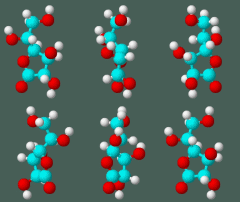
A large prospective population-based study published in Nutrients has reported that regular vitamin C supplementation was associated with a significantly lower risk of developing multiple sclerosis (MS), adding important new epidemiologic evidence to the growing body of research linking nutritional status with autoimmune and neurodegenerative diseases. The investigators analyzed data from 486,908 participants enrolled in the UK Biobank who were free of neurological disease at baseline. Participants were followed for a median of 13.5 years, during which 452 individuals developed multiple sclerosis. After adjustment for demographic characteristics, lifestyle factors, dietary habits, socioeconomic status, and other measured confounders using propensity-score weighting, regular vitamin C supplementation was associated with an approximately 49% lower incidence of multiple sclerosis compared with non-users (hazard ratio 0.51). Interestingly, the association appeared relatively specific to vitamin C. Neither general dietary supplement use nor multivitamin supplementation demonstrated a similar reduction in MS risk, suggesting that the findings were not simply explained by healthier lifestyles among supplement users. The protective association was also strongest among individuals with moderate or high genetic susceptibility to multiple sclerosis. Why These Findings MatterMultiple sclerosis is a chronic immune-mediated disease characterized by inflammatory demyelination and progressive neurodegeneration within the central nervous system. Although its precise cause remains incompletely understood, oxidative stress, chronic inflammation, mitochondrial dysfunction, immune dysregulation, and impairment of the blood-brain barrier are widely recognized contributors to disease development and progression. Vitamin C is best known as an antioxidant, but its biological functions extend far beyond free radical scavenging. It participates in immune regulation, collagen synthesis, endothelial function, mitochondrial metabolism, leukocyte activity, and numerous enzymatic reactions essential for maintaining normal physiological function and tissue integrity. These well-established biological roles provide plausible mechanisms through which adequate vitamin C status could influence susceptibility to immune-mediated disorders such as multiple sclerosis. Strengths of the StudySeveral features strengthen confidence in the reported association. The study included nearly half a million participants, providing exceptional statistical power. Because vitamin C supplementation was recorded before disease onset, the prospective design substantially reduces the possibility of reverse causation. In addition, the investigators employed propensity-score weighting together with multiple sensitivity analyses to minimize bias arising from measured differences in health behaviors, diet, and socioeconomic status. Although observational studies cannot establish causality, large prospective cohort studies remain among the strongest epidemiologic approaches for identifying potentially modifiable risk factors deserving further investigation. Important LimitationsThe investigators appropriately emphasize that the study demonstrates an association, not proof of causation. Vitamin C use was self-reported at enrollment, and information regarding dosage, duration of supplementation, adherence, and changes during follow-up was unavailable. As with all observational studies, residual confounding cannot be completely excluded despite extensive statistical adjustment. Accordingly, these findings should be viewed as important new evidence rather than definitive proof that vitamin C supplementation prevents multiple sclerosis. Confirmation in independent populations, mechanistic studies, and randomized clinical trials will be necessary before clinical recommendations can be based on these observations. An Orthomolecular PerspectiveOrthomolecular medicine has long emphasized that maintaining optimal nutritional status supports normal physiological function and may enhance resilience against chronic disease. The present study does not establish that vitamin C alone prevents multiple sclerosis. Rather, it adds meaningful epidemiologic evidence to a growing body of literature suggesting that nutritional status may influence susceptibility to immune-mediated disorders. Given vitamin C's established roles in antioxidant defense, immune regulation, vascular integrity, collagen synthesis, mitochondrial function, and tissue repair, the reported association is biologically plausible and merits further investigation. From the perspective of Integrative Orthomolecular Systems Medicine (I-OM), chronic diseases such as multiple sclerosis are unlikely to arise from a single cause-or be prevented by a single intervention. Instead, optimal micronutrient status, including adequate vitamin C, should be viewed as one component of a comprehensive systems approach that also addresses metabolic health, oxidative stress, inflammation, vascular integrity, mitochondrial function, lifestyle, and other determinants of long-term physiological resilience. Looking AheadThis large prospective study provides important new epidemiologic evidence linking regular vitamin C supplementation with a substantially lower incidence of multiple sclerosis. Whether this association reflects a true causal protective effect remains uncertain. Nevertheless, the findings provide a strong rationale for additional mechanistic research, replication in other populations, and well-designed randomized clinical trials. As our understanding of nutrition and autoimmune disease continues to evolve, studies such as this underscore the importance of investigating safe, accessible, and biologically plausible nutritional strategies that may contribute to disease prevention and long-term neurological health. Editorial Note (OMNS)The Orthomolecular Medicine News Service reports new scientific findings relevant to nutrition, orthomolecular medicine, and integrative health. This article summarizes a recently published prospective cohort study. The reported findings demonstrate an observational association and should not be interpreted as establishing a causal relationship or as a basis for changing clinical practice without further evidence. ReferenceAssociation of Vitamin C Supplementation and Genetic Susceptibility with Multiple Sclerosis Risk: A Prospective Population-Based Cohort Study. Nutrients. 2026;18(14):2367. doi: 10.3390/nu18142367 Reader Discussion and QuestionsOMNS welcomes comments, questions, ideas, experiences, and respectful dialogue from readers, patients, healthcare professionals, researchers, and students worldwide. We encourage participation on OMNS Interactive, where the exchange of knowledge and perspectives helps advance understanding and foster meaningful discussion. Join the conversation:
About OMNS InteractiveOMNS Interactive is the discussion and commentary platform of the Orthomolecular Medicine News Service (OMNS). The original OMNS website remains the official archive of OMNS publications. Subscribe to OMNS Interactive for future articles, commentary, and discussions:
Content is provided for educational purposes only and does not constitute medical advice. Follow OMNS Interactive
Orthomolecular MedicineOrthomolecular medicine uses safe, effective nutritional therapy to fight illness. For more information: http://www.orthomolecular.org Find a DoctorTo locate an orthomolecular physician near you: http://orthomolecular.org/resources/omns/v06n09.shtml The peer-reviewed Orthomolecular Medicine News Service is a non-profit and non-commercial informational resource. Editorial Review Board:
Jennifer L. Aliano, M.S., L.Ac., C.C.N. (USA)
Comments and media contact: editor@orthomolecular.org OMNS welcomes but is unable to respond to individual reader emails. Reader comments become the property of OMNS and may or may not be used for publication. To Subscribe at no charge: https://www.orthomolecular.org/subscribe.html To Unsubscribe from this list: https://www.orthomolecular.org/unsubscribe.html |

This website is managed by Riordan Clinic
A Non-profit 501(c)(3) Medical, Research and Educational Organization
3100 North Hillside Avenue, Wichita, KS 67219 USA
Phone: 316-682-3100; Fax: 316-682-5054
© (Riordan Clinic) 2004 - 2024c
Information on Orthomolecular.org is provided for educational purposes only. It is not intended as medical advice.
Consult your orthomolecular health care professional for individual guidance on specific health problems.
