|
|
|
|
|
|
This article may be reprinted free of charge provided 1) that there is clear attribution to the Orthomolecular Medicine News Service, and 2) that both the OMNS free subscription link http://orthomolecular.org/subscribe.html and also the OMNS archive link http://orthomolecular.org/resources/omns/index.shtml are included.
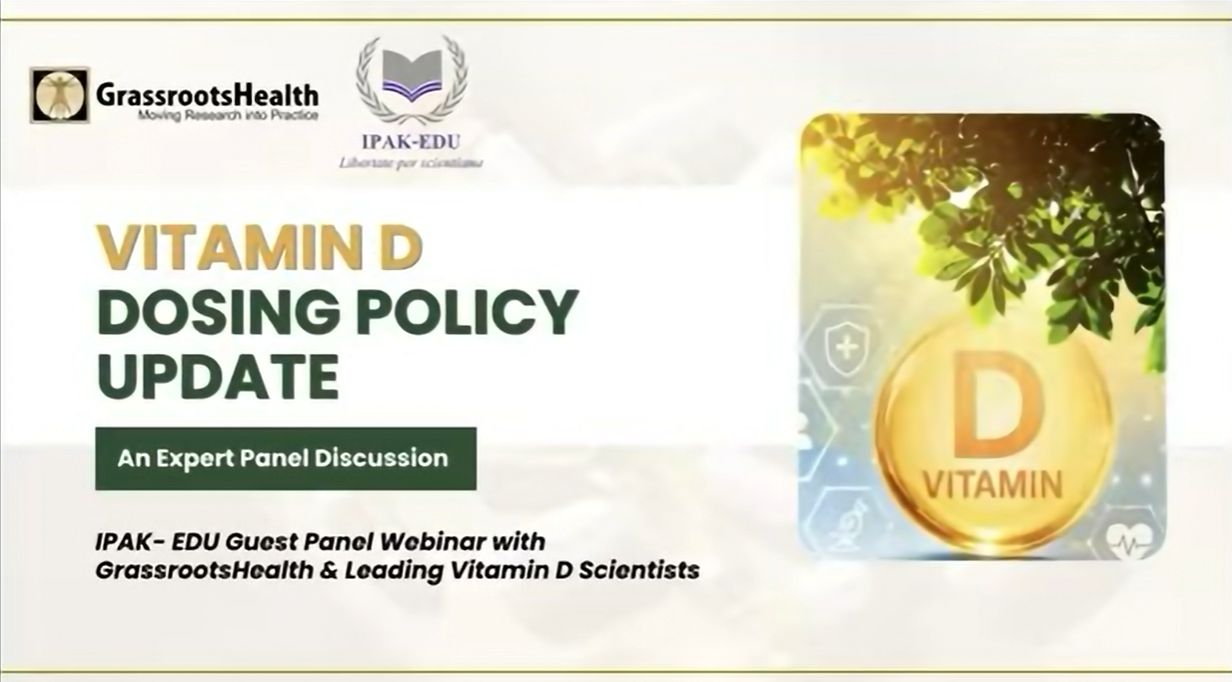
International Vitamin D Dosing Policy Update:Expert Panel Consensus and an IOM Systems Medicine PerspectiveOn May 21, 2026, GrassrootsHealth and IPAK-EDU convened an international expert panel webinar titled "Vitamin D Dosing Policies Update." The event brought together many of the world's leading vitamin D researchers, clinicians, and public health experts to discuss current evidence, clinical implementation, biological variability, vitamin D resistance, and future directions for vitamin D policy. The webinar featured Dr. Michael Holick, Dr. Sunil Wimalawansa, Dr. William Grant, Dr. Edward Giovannucci, Dr. Bruce Hollis, Dr. Carol Wagner, Dr. Scott Weiss, Dr. Hooman Mirzakhani, Dr. Leigh Frame, Dr. Beth Sanford, and Dr. Richard Cheng, among others. The discussion was moderated by Jennifer Aliano, Executive Director of GrassrootsHealth. Watch the Full ForumThe complete webinar recording is available here:
https://www.grassrootshealth.net/blog/leading-experts-call-for-changes-to-vitamin-d-policy-watch-the-discussion/ or https://youtu.be/M6Bp0pIvWk8?si=F7WetkDQO2M24-cD The webinar reflected a growing recognition that vitamin D deficiency remains a major global public health issue and that current recommendations may not adequately account for individual biological variability or the expanding body of evidence regarding optimal vitamin D status. Although the panelists represented diverse disciplines and perspectives, several common themes emerged, including:
The following article is divided into two parts. Part I summarizes the key messages presented by the expert panel. Part II presents the IOM Systems Medicine Clinical Guidance framework for vitamin D optimization. This section reflects the perspective of IOM Systems Medicine and OMNS and should not be interpreted as an official position of the expert panel itself. Part IThe following summaries are presented in the order of the speakers' presentations. Jennifer L. Aliano, MS, LAc, CCNExecutive Director, GrassrootsHealth Host and ModeratorMs. Jennifer Aliano opened the webinar by welcoming participants and outlining the purpose of the forum: to examine current vitamin D dosing policies in light of emerging scientific evidence and growing recognition of individual biological variability. She emphasized GrassrootsHealth's longstanding mission of translating scientific research into practical public health applications and highlighted the importance of bridging the gap between research findings and real-world implementation. Ms. Aliano noted that despite decades of vitamin D research, deficiency and insufficiency remain widespread globally. She stressed the need for evidence-based public health strategies that recognize differences in individual responses to vitamin D and support personalized approaches to achieving optimal health. Throughout the webinar, Ms. Aliano guided the discussion by connecting themes across presentations and encouraging dialogue among researchers, clinicians, and public health professionals. Key message: Scientific evidence must ultimately be translated into practical, accessible, and effective public health strategies that improve health outcomes at the population level. James Lyons-Weiler, PhDIPAK; MAHA Institute The Statistical Mistake by the IOMDr. Lyons-Weiler examined the statistical methods used in the development of the Institute of Medicine (IOM) vitamin D recommendations. He discussed how different statistical assumptions and analytical approaches can influence estimates of vitamin D requirements and population recommendations. Key points:
Key message: Statistical methodology plays a critical role in determining vitamin D recommendations and deserves careful scrutiny. Michael Holick, PhD, MDBoston University School of Medicine IOM / Endocrine Society Guidelines: History and ShortcomingsDr. Holick reviewed the history of vitamin D guideline development and discussed limitations of previous recommendations. Key points:
Sunil J. Wimalawansa, MD, PhD, MBAFormer Professor of Medicine, Rutgers University Vitamin D FundamentalsDr. Wimalawansa provided an overview of vitamin D physiology, metabolism, and biological variability. Key points:
William B. Grant, PhDSunlight, Nutrition and Health Research Center Importance of Observational StudiesDr. Grant reviewed evidence from epidemiological and observational studies linking vitamin D status to health outcomes. Key points:
Edward Giovannucci, MD, ScDHarvard T.H. Chan School of Public Health Insights from Randomized Controlled Trials and Mendelian RandomizationDr. Giovannucci discussed strengths and limitations of randomized controlled trials (RCTs) and Mendelian randomization studies in vitamin D research. Key points:
Carol Wagner, MDMedical University of South Carolina Vitamin D Effects on Prenatal and Newborn HealthDr. Wagner reviewed evidence regarding maternal vitamin D status and fetal development. Key points:
Bruce Hollis, PhDMedical University of South Carolina Vitamin D, Lactation, and Early ChildhoodDr. Hollis discussed vitamin D requirements during breastfeeding and early childhood. Key points:
Scott Weiss, MDHarvard Medical School / Brigham and Women's Hospital Pregnancy: Scientific Issues Needing to Be AddressedDr. Weiss discussed remaining research questions regarding vitamin D and pregnancy. Key points:
Hooman Mirzakhani, MD, MMSc, PhDBrigham and Women's Hospital / Harvard Medical School Pregnancy: Trials Needed to Address Outstanding QuestionsDr. Mirzakhani reviewed future research priorities in maternal-fetal vitamin D science. Key points:
Leigh Frame, PhD, MHSGeorge Washington University Vitamin D and Immune Health: Hospitalizations and SurgeriesDr. Frame reviewed evidence linking vitamin D status to immune function and clinical outcomes. Key points:
Richard Z. Cheng, MD, PhDEditor-in-Chief, Orthomolecular Medicine News Service Why Clinical Responses to Vitamin D Vary: A Systems Medicine PerspectiveDr. Cheng discussed the observation that individuals frequently exhibit different clinical responses despite having similar serum vitamin D levels. Key points:
Beth Sanford, DNP, RNDirector of Education and Clinical Practice, GrassrootsHealth Implementation into Clinical Practice and Public HealthDr. Sanford concluded the forum by focusing on implementation. Key points:
Overall Forum ConsensusDespite differences in emphasis, the panel broadly agreed on several important principles:
The following section presents the IOM Systems Medicine Clinical Guidance framework for vitamin D optimization. This framework reflects the perspective of IOM Systems Medicine and OMNS and should not be interpreted as an official position of the panel itself. Part IICommentary: An IOM Systems Medicine Perspective on Vitamin D OptimizationThe preceding section summarized the presentations and discussions from the GrassrootsHealth International Vitamin D Policy Forum. The following section was not part of the forum presentations or panel consensus statement. Rather, it represents the perspective of IOM Systems Medicine (Integrative Orthomolecular Systems Medicine) and reflects the author's interpretation of the current scientific literature, including the evidence review published by Grant, Wimalawansa, Pludowski, and Cheng (Nutrients, 2025). Interpreting the TPIM Vitamin D Guidance Framework
Vitamin D (25[OH]D) Clinical Guidance: A TPIM Framework for Safe, Effective, Affordable, and Mass-Applicable Health Optimization. One of the foundational principles of IOM Systems Medicine is: Deficiency and toxicity define the boundaries. For vitamin D, deficiency represents the lower boundary of physiological adequacy, while toxicity represents the upper boundary of physiological safety. Between these boundaries lies a broad safety window within which individuals may pursue optimal health outcomes. The TPIM framework (Safe, Proven Effective, Inexpensive, and Mass-Applicable) provides a practical approach for evaluating preventive health interventions. Vitamin D is one of the clearest examples of a TPIM intervention because it is generally safe, effective, affordable, and widely accessible. As illustrated in the figure, IOM Systems Medicine considers:
Key Take-Home MessageDeficiency and toxicity define the boundaries. Optimization occurs within the safety window. For vitamin D-and many other essential nutrients-the goal is not merely to avoid deficiency, but to achieve optimal physiological function while remaining safely within established biological limits. Editor's NoteThe vitamin D guidance framework presented in Part II reflects the perspective of IOM Systems Medicine and OMNS. It should not be interpreted as an official position or consensus statement of the GrassrootsHealth forum participants. ReferenceGrant WB, Wimalawansa SJ, Pludowski P, Cheng RZ. Vitamin D: Evidence-Based Health Benefits and Recommendations for Population Guidelines. Nutrients. 2025;17(2):277. Reader Discussion and QuestionsOMNS welcomes comments, questions, ideas, experiences, and respectful dialogue from readers, patients, healthcare professionals, researchers, and students worldwide. We encourage participation on OMNS Interactive, where the exchange of knowledge and perspectives helps advance understanding and foster meaningful discussion. Join the conversation:
About OMNS InteractiveOMNS Interactive is the discussion and commentary platform of the Orthomolecular Medicine News Service (OMNS). The original OMNS website remains the official archive of OMNS publications. Subscribe to OMNS Interactive for future articles, commentary, and discussions:
Content is provided for educational purposes only and does not constitute medical advice. Follow OMNS Interactive
Orthomolecular MedicineOrthomolecular medicine uses safe, effective nutritional therapy to fight illness. For more information: http://www.orthomolecular.org Find a DoctorTo locate an orthomolecular physician near you: http://orthomolecular.org/resources/omns/v06n09.shtml The peer-reviewed Orthomolecular Medicine News Service is a non-profit and non-commercial informational resource. Editorial Review Board:
Jennifer L. Aliano, M.S., L.Ac., C.C.N. (USA)
Comments and media contact: editor@orthomolecular.org OMNS welcomes but is unable to respond to individual reader emails. Reader comments become the property of OMNS and may or may not be used for publication. To Subscribe at no charge: https://www.orthomolecular.org/subscribe.html To Unsubscribe from this list: https://www.orthomolecular.org/unsubscribe.html |

This website is managed by Riordan Clinic
A Non-profit 501(c)(3) Medical, Research and Educational Organization
3100 North Hillside Avenue, Wichita, KS 67219 USA
Phone: 316-682-3100; Fax: 316-682-5054
© (Riordan Clinic) 2004 - 2024c
Information on Orthomolecular.org is provided for educational purposes only. It is not intended as medical advice.
Consult your orthomolecular health care professional for individual guidance on specific health problems.

![Vitamin D (25[OH]D) Clinical Guidance](v22n31-fig2.jpg)