|
|
|
|
|
|
This article may be reprinted free of charge provided 1) that there is clear attribution to the Orthomolecular Medicine News Service, and 2) that both the OMNS free subscription link http://orthomolecular.org/subscribe.html and also the OMNS archive link http://orthomolecular.org/resources/omns/index.shtml are included.
A New Comprehensive Review: Cholesterol Is Not the Root Cause of Heart DiseaseBy Richard Z. Cheng, MD, PhD
Key Highlights
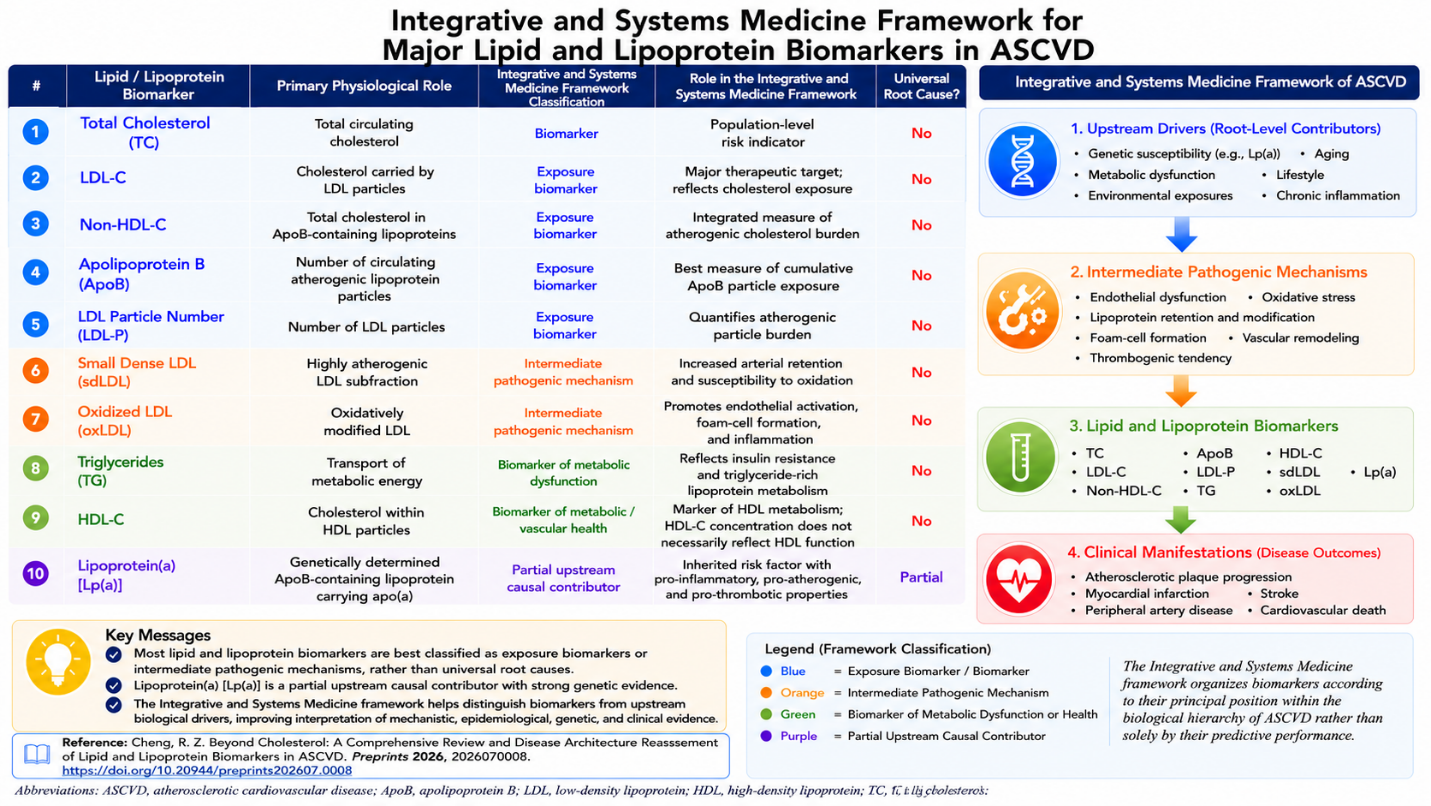
Why Has Cardiovascular Medicine Kept Changing Lipid Biomarkers?For more than sixty years, cholesterol has occupied center stage in cardiovascular medicine. During this period, researchers have introduced an increasingly sophisticated array of lipid biomarkers in an effort to improve cardiovascular risk assessment and better understand the biology of atherosclerosis. The field evolved from total cholesterol to LDL cholesterol, and later to apolipoprotein B (ApoB), LDL particle number (LDL-P), small dense LDL (sdLDL), oxidized LDL (oxLDL), and renewed clinical interest in lipoprotein(a) [Lp(a)]. Each new biomarker represented genuine scientific progress. Each improved cardiovascular risk prediction. Each addressed important limitations of the biomarkers that came before it. Yet this remarkable history raises a question that has received surprisingly little attention. Why has cardiovascular medicine repeatedly needed a new "best" lipid biomarker? If each successive biomarker represented the true root cause of atherosclerosis, why has the field continued searching for another, and then another? In medicine, long-term prevention and, where possible, durable disease reversal generally depend on understanding and addressing the upstream biological processes that initiate disease-not simply modifying intermediate pathogenic mechanisms or treating downstream clinical manifestations after they have developed. Identifying those upstream drivers is therefore essential for advancing true root-cause prevention. For more than six decades, cardiovascular medicine has progressively refined measurements of downstream lipid biology without fully identifying the upstream biological drivers that initiate ASCVD. A newly released MDPI Preprint, Beyond Cholesterol: A Comprehensive Integrative and Systems Medicine Reassessment of Lipid and Lipoprotein Biomarkers in ASCVD, takes an unconventional approach. Rather than comparing lipid biomarkers primarily according to their ability to predict cardiovascular risk, it asks a more fundamental question: What biological role does each biomarker play within the pathogenesis of ASCVD? To answer this question, the review synthesizes approximately 280 peer-reviewed publications spanning more than six decades of cardiovascular research. The review reaches a provocative conclusion. The continual evolution of lipid biomarkers does not necessarily reflect progressively deeper discoveries of the biological root causes of ASCVD. Instead, it largely reflects progressively more refined measurements of the same downstream biological pathway. Important Players-but Mostly Not the Root CauseThe review does not argue that lipid biology is unimportant. Nor does it deny that lipid-lowering therapies can reduce cardiovascular events. Rather, it proposes that the greatest limitation of the traditional lipid-centric paradigm is one of biological classification. For decades, cardiovascular medicine has largely assumed that increasingly sophisticated lipid biomarkers would eventually identify the fundamental cause of atherosclerosis. Our review suggests a different interpretation. Most major lipid biomarkers are better understood as biomarkers of exposure or intermediate pathogenic mechanisms than as the upstream biological drivers that initiate vascular disease. In other words, cardiovascular medicine has become increasingly successful at measuring and modifying lipid biology. But lipid biology itself may not represent where ASCVD actually begins. This distinction may help explain why decades of remarkable advances in lipid research have improved cardiovascular risk prediction without fully resolving the question of disease initiation. A Different Way to Understand the Evolution of Lipid BiomarkersThe history of lipid research can be viewed as a continuing effort to improve the precision of cardiovascular risk assessment. Total cholesterol proved helpful but lacked specificity. LDL cholesterol provided better prediction. ApoB more accurately reflected the number of circulating atherogenic particles. LDL particle number further refined assessment of lipoprotein burden. Small dense LDL and oxidized LDL improved understanding of plaque formation and vascular injury. More recently, Lp(a) has emerged as an important genetically determined cardiovascular risk factor. Viewed individually, each advance represents important scientific progress. Viewed collectively, however, they tell a different story. Rather than uncovering progressively deeper root causes of ASCVD, these biomarkers appear to describe different aspects of the same downstream biological pathway. This observation forms one of the central conclusions of our review. The question, therefore, may not be: Which lipid biomarker is best? Instead, the more fundamental question becomes: Where does each biomarker fit within the disease process? That simple shift in perspective changes how the entire field may be interpreted. Understanding How ASCVD Develops
One of the central conclusions of this review is that ASCVD should be understood as a biological process rather than explained by any single biomarker. Instead of treating every lipid biomarker as a potential root cause, the review distinguishes four distinct components of disease development:
Failure to distinguish these levels has contributed to decades of confusion. A biomarker can predict disease extremely well without representing the earliest initiating cause. Likewise, an intermediate pathogenic mechanism may contribute directly to plaque formation while still remaining downstream of more fundamental biological disturbances. Recognizing these distinctions provides a more coherent Integrative and Systems Medicine framework for integrating physiology, pathophysiology, epidemiology, genetics, and randomized clinical trials. More importantly, it suggests that the future of cardiovascular medicine may depend less on discovering yet another lipid biomarker and more on identifying the upstream biological disturbances that give rise to them in the first place. Where Do the Major Lipid Biomarkers Fit?To answer this question, the review systematically evaluates each major lipid biomarker using five independent domains of scientific evidence:
Each addresses a different scientific question. No single line of evidence is sufficient by itself. Only by integrating all five can the biological role of each biomarker be properly understood. The review concludes that the major lipid biomarkers occupy different positions within the overall disease process of ASCVD. LDL-C, ApoB, and LDL Particle Number (LDL-P) primarily quantify cumulative exposure to circulating atherogenic lipoproteins. They are excellent exposure biomarkers and valuable therapeutic targets, but they do not appear to represent the universal initiating causes of vascular disease. Small dense LDL (sdLDL) and oxidized LDL (oxLDL) participate directly in endothelial injury, foam-cell formation, oxidative stress, and plaque progression. Their biological role is more appropriately classified as intermediate pathogenic mechanisms. Triglycerides (TG) and HDL cholesterol (HDL-C) largely reflect broader metabolic physiology, including insulin sensitivity, hepatic metabolism, and systemic energy regulation. They provide important information about metabolic health but are unlikely to function as independent root drivers of ASCVD. Among all currently recognized lipid biomarkers, lipoprotein(a) [Lp(a)] stands apart. Human genetic studies consistently support an inherited causal contribution to cardiovascular risk. Nevertheless, our review concludes that even Lp(a) is best understood as a partial upstream causal contributor, rather than a universal explanation for atherosclerosis. Taken together, these observations suggest that the major lipid biomarkers complement rather than compete with one another. Each provides valuable insight into a different stage of the disease process. However, with the partial exception of Lp(a), most function primarily as exposure biomarkers or intermediate pathogenic mechanisms rather than the upstream biological drivers that initiate ASCVD. Why Lowering Lipids Does Not Necessarily Eliminate the Root CauseOne of the most important distinctions made in this review is the difference between therapeutic benefit and biological causation. There is little doubt that lipid-lowering therapies have advanced cardiovascular medicine. Numerous clinical trials have demonstrated reductions in cardiovascular events with statins, ezetimibe, PCSK9 inhibitors, and other lipid-lowering approaches. However, an important scientific question remains. Does improving a biological pathway prove that the pathway is the original cause of disease? History suggests otherwise. Medicine frequently succeeds by modifying downstream mechanisms without completely correcting the upstream disturbances that initiated the disease. Lowering blood glucose does not necessarily reverse insulin resistance. Reducing blood pressure does not eliminate all of the biological factors responsible for hypertension. Similarly, improving lipid profiles does not necessarily establish that lipid abnormalities are the earliest biological drivers of ASCVD. Perhaps the strongest evidence supporting this distinction is the persistence of substantial residual cardiovascular risk despite increasingly intensive lipid-lowering therapy. If lipid abnormalities represented the complete explanation for ASCVD, progressively more effective lipid lowering might be expected to eliminate most cardiovascular risk. That has not occurred. Instead, the persistence of residual risk suggests that important upstream biological disturbances remain active. Looking Beyond CholesterolIf most lipid biomarkers are not the earliest biological drivers of ASCVD, where should cardiovascular medicine focus next? Our review suggests shifting greater attention toward upstream biological disturbances that precede lipid abnormalities and initiate vascular injury. These upstream processes are likely multifactorial and interconnected. They may include metabolic dysfunction, insulin resistance, chronic inflammation, oxidative stress, endothelial dysfunction, impaired vascular repair, micronutrient insufficiency, environmental toxicant exposure, chronic infections, and other interacting biological processes. From an Integrative Orthomolecular Systems Medicine (IOM) perspective, these upstream disturbances represent the biological terrain upon which lipid abnormalities subsequently develop. Rather than replacing lipid biology, this broader systems perspective places lipid biomarkers within their appropriate biological context. In this view, lipid abnormalities become important components of disease progression-but not necessarily the earliest initiating events. A Paradigm Shift for Cardiovascular MedicineFor more than sixty years, cardiovascular medicine has pursued increasingly sophisticated lipid biomarkers in an effort to better understand ASCVD. That effort has unquestionably advanced our understanding of vascular biology and improved cardiovascular risk assessment. Our review, however, suggests that the continual evolution of lipid biomarkers also tells another story. It suggests that cardiovascular medicine has become increasingly precise at measuring downstream biology while the upstream biological drivers of disease remain incompletely understood. The next major breakthrough in ASCVD may therefore not come from discovering yet another lipid biomarker. It may come from identifying the upstream biological disturbances that give rise to those biomarkers. That shift-from managing downstream manifestations toward understanding upstream biological drivers-represents the central message of this comprehensive review. The future of cardiovascular medicine should not abandon lipid biology. Rather, it should place lipid biomarkers within the broader disease process, distinguishing upstream biological drivers from exposure biomarkers, intermediate pathogenic mechanisms, and clinical manifestations. For more than sixty years, cardiovascular medicine has searched for increasingly sophisticated lipid biomarkers. Our review suggests that the next major breakthrough may not come from discovering another biomarker. It may come from identifying and correcting the upstream biological disturbances that give rise to them. This systems-based, root-cause approach lies at the heart of Integrative Orthomolecular Systems Medicine (IOM) and, ultimately, is what it means to move beyond cholesterol. ReferenceCheng, R. Z. Beyond Cholesterol: A Comprehensive Integrative and Systems Medicine Reassessment of Lipid and Lipoprotein Biomarkers in ASCVD. Preprints 2026, 2026070008. https://doi.org/10.20944/preprints202607.0008.v1 Reader Discussion and QuestionsOMNS welcomes comments, questions, ideas, experiences, and respectful dialogue from readers, patients, healthcare professionals, researchers, and students worldwide. We encourage participation on OMNS Interactive, where the exchange of knowledge and perspectives helps advance understanding and foster meaningful discussion. Join the conversation:
About OMNS InteractiveOMNS Interactive is the discussion and commentary platform of the Orthomolecular Medicine News Service (OMNS). The original OMNS website remains the official archive of OMNS publications. Subscribe to OMNS Interactive for future articles, commentary, and discussions:
Content is provided for educational purposes only and does not constitute medical advice. Follow OMNS Interactive
Orthomolecular MedicineOrthomolecular medicine uses safe, effective nutritional therapy to fight illness. For more information: http://www.orthomolecular.org Find a DoctorTo locate an orthomolecular physician near you: http://orthomolecular.org/resources/omns/v06n09.shtml The peer-reviewed Orthomolecular Medicine News Service is a non-profit and non-commercial informational resource. Editorial Review Board:
Jennifer L. Aliano, M.S., L.Ac., C.C.N. (USA)
Comments and media contact: editor@orthomolecular.org OMNS welcomes but is unable to respond to individual reader emails. Reader comments become the property of OMNS and may or may not be used for publication. To Subscribe at no charge: https://www.orthomolecular.org/subscribe.html To Unsubscribe from this list: https://www.orthomolecular.org/unsubscribe.html |

This website is managed by Riordan Clinic
A Non-profit 501(c)(3) Medical, Research and Educational Organization
3100 North Hillside Avenue, Wichita, KS 67219 USA
Phone: 316-682-3100; Fax: 316-682-5054
© (Riordan Clinic) 2004 - 2024c
Information on Orthomolecular.org is provided for educational purposes only. It is not intended as medical advice.
Consult your orthomolecular health care professional for individual guidance on specific health problems.