|
|
|
|
|
|
This article may be reprinted free of charge provided 1) that there is clear attribution to the Orthomolecular Medicine News Service, and 2) that both the OMNS free subscription link http://orthomolecular.org/subscribe.html and also the OMNS archive link http://orthomolecular.org/resources/omns/index.shtml are included.
New Alzheimer's Study Raises Questions About Glucosamine:Why the IOM Nutrient Prioritization Principle MattersBy Richard Z. Cheng, MD, PhD
Highlights
A New Study Raises Questions About GlucosamineA recently published study in Nature Metabolism reported that glucosamine supplementation accelerated Alzheimer's disease progression in mouse models and was associated with worse outcomes among patients with dementia. [1] The study quickly attracted attention because glucosamine is one of the world's most widely used dietary supplements, commonly taken for joint health. However, the most important lesson from this study may not be about glucosamine itself. Rather, it highlights a larger issue that is often overlooked in nutrition and supplement discussions: not all nutrients and supplements deserve equal priority. The IOM Nutrient Prioritization Principle, recently proposed as a systems framework for nutritional intervention [5], provides a practical method for distinguishing foundational nutritional and metabolic needs from supportive and optimization strategies. What the New Study FoundResearchers identified a phenomenon they called hyperglycosylation in Alzheimer's disease. In mouse models:
The investigators also analyzed electronic health records from patients with dementia and reported an association between glucosamine use and:
These findings are intriguing and deserve further study. However, several important limitations should be noted. Association Is Not CausationThe human portion of the study was observational rather than a randomized clinical trial. Therefore, the findings demonstrate an association but do not prove that glucosamine causes dementia. Importantly, some previous population studies have reported the opposite association, suggesting potential benefits among glucosamine users. The overall evidence remains mixed, and further research is needed. The Bigger Question: Where Does Glucosamine Belong?Regardless of whether the proposed mechanism ultimately proves clinically important, the study raises a broader practical question: Where should glucosamine fit within an overall nutritional strategy? This is where many consumers become confused. Modern supplement markets contain thousands of products, including:
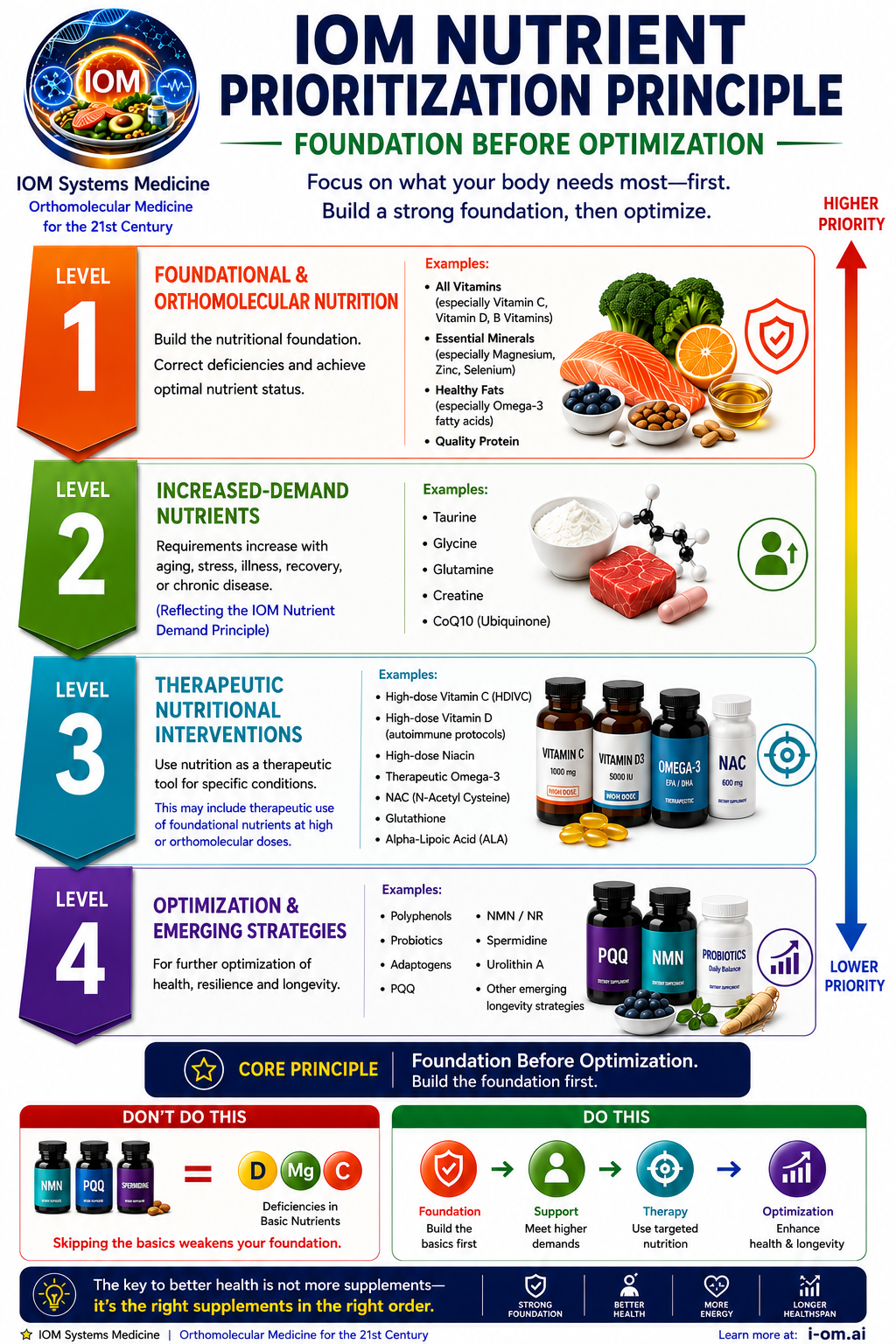
Consumers are often led to believe that newer and more specialized supplements are automatically better. In reality, physiology does not work that way. This is where the IOM Nutrient Prioritization Principle may provide a useful framework. The IOM Nutrient Prioritization PrincipleThe IOM Nutrient Prioritization Principle provides a simple systems-based framework for nutritional decision-making [5]. As illustrated in Figure 1 (adapted from [5]), nutritional interventions can be broadly organized into four levels:
The hierarchy reflects a central principle: Foundation Before OptimizationThe goal is not to discourage the use of specialized supplements. Rather, it is to place them in their proper context. Nutritional and metabolic foundations should be addressed first. Increased physiological demands should be recognized and supported. Therapeutic nutritional interventions may be used when clinically appropriate. Optimization and longevity-oriented strategies can then be considered after these foundational needs have been met. From an IOM perspective, glucosamine is best viewed as a supportive supplement rather than a foundational nutritional requirement. The more important question is not whether glucosamine works. The more important question is: Where does glucosamine belong within an overall health strategy? Figure 1. The IOM Nutrient Prioritization Principle (adapted from [5]).
Foundation Before OptimizationThe central principle is simple: Build the foundation first. Before pursuing increasingly specialized interventions, nutritional and metabolic foundations should be addressed first. From an IOM perspective, glucosamine is best viewed as a targeted supportive supplement rather than a foundational nutritional requirement. The more important question is not whether glucosamine works. The more important question is: Where does glucosamine belong within an overall health strategy? Do We Really Need Glucosamine for Joint Health?The purpose of the IOM Nutrient Prioritization Principle is not to discourage the use of glucosamine or other supportive supplements. Rather, it is to place them in their proper context. Before asking whether glucosamine is beneficial, it may be worth asking a more fundamental question: Are the nutritional, metabolic, and lifestyle foundations for joint health already in place? For bone and joint health, IOM Systems Medicine emphasizes addressing foundational physiological requirements first. Core Nutritional Foundations
These nutrients play important roles in:
Metabolic and Lifestyle Foundations Equally important are:
From an IOM perspective, osteoporosis and degenerative joint disease are rarely the result of a single nutrient deficiency. They are usually manifestations of broader disturbances involving nutrition, metabolism, inflammation, hormonal balance, connective tissue integrity, and aging-related physiological decline. In IOM Systems Medicine, the goal is not to find a single "magic supplement" for bone or joint health. The goal is to create the biological conditions that allow tissues to maintain, repair, and regenerate themselves as effectively as possible. A Personal Perspective: Foundations Before SupplementsThis discussion of glucosamine brings to mind a personal experience. Nearly 20 years ago, when I first started playing badminton, I had persistent right shoulder pain and knee soreness when climbing stairs. Around the same time, I adopted a low-carbohydrate ketogenic diet, practiced intermittent fasting, and focused on foundational nutrition, including vitamin C, vitamin D, magnesium, omega-3 fatty acids, and mitochondrial-support nutrients. Notably, I never took pain medications, glucosamine, or other joint supplements. Over time, my shoulder pain disappeared, and my knee discomfort resolved. Today, at age 66, I continue to play badminton three to four times per week, often for two to three hours at a time. I regularly compete with players 20 to 40 years younger and maintain excellent mobility and endurance. While anecdotal, this experience illustrates an important principle of IOM Systems Medicine. Rather than focusing on a single supplement for a single symptom, I focused on improving the body's overall physiological environment. The goal was not simply to reduce joint pain, but to improve the body's capacity to maintain, repair, and regenerate itself. This experience reinforced my belief that foundational nutrition and metabolic health should come first. In many cases, restoring the foundation may matter more than finding the perfect supplement. The Bottom LineThe glucosamine study raises important scientific questions and deserves further investigation. However, its greatest value may lie elsewhere. It reminds us that nutritional interventions should be prioritized according to biological importance rather than marketing popularity. The goal of nutritional medicine is not to take more supplements. The goal is to identify which interventions matter most. Before asking whether a specialized supplement is beneficial, it may be worth asking a more fundamental question: Have the nutritional, metabolic, and lifestyle foundations already been addressed? In IOM Systems Medicine, the guiding principle is simple: Foundation Before Optimization The right supplement at the wrong priority level may provide little benefit. The right foundation, however, often changes everything. AcknowledgmentThe author thanks Michael Passwater and Patrick Holford for bringing this study to his attention. References1. Hawkinson TR, Liu Z, Ribas RA, Medina T, Nielsen RS, Clarke HA, Ma X, Mueller AC, Plasencia AF, Sheer AL, Simpson ST, Soto CM, Sudderth J, Cai F, Cantrell AR, Colpaert MG, Shedlock CJ, Wu L, Young LEA, Kooser DD, Chen L, Ryan AM, Quinones S, Son J, Azadi P, DeBerardinis RJ, Prokop S, Allison D, Yang S, Chen H, Huang Y, He X, Alonge KM, Guo J, Guo Y, Bian J, Vander Kooi CW, Gentry MS, Sun RC. Hyperglycosylation is a metabolic driver of Alzheimer's disease. Nature Metabolism. 2026 Jun 9. doi:10.1038/s42255-026-01538-4 2. Ames BN. Low micronutrient intake may accelerate the degenerative diseases of aging through allocation of scarce micronutrients by triage. Proc Natl Acad Sci USA. 2006;103(47):17589-17594. 3. Ames BN. Prolonging healthy aging: longevity vitamins and proteins. Proc Natl Acad Sci USA. 2018;115(43):10836-10844. 4. Grant WB, Wimalawansa SJ, Pludowski P, Cheng RZ, et al. Vitamin D supplementation guidelines and health outcomes. Nutrients. 2025;17(2):277. 5. Cheng RZ. The IOM Nutrient Prioritization Principle: A Systems Framework for Nutritional Intervention. Preprints. 2026;2026061697. doi:10.20944/preprints202606.1697.v1 Reader Discussion and QuestionsOMNS welcomes comments, questions, ideas, experiences, and respectful dialogue from readers, patients, healthcare professionals, researchers, and students worldwide. We encourage participation on OMNS Interactive, where the exchange of knowledge and perspectives helps advance understanding and foster meaningful discussion. Join the conversation:
About OMNS InteractiveOMNS Interactive is the discussion and commentary platform of the Orthomolecular Medicine News Service (OMNS). The original OMNS website remains the official archive of OMNS publications. Subscribe to OMNS Interactive for future articles, commentary, and discussions:
Content is provided for educational purposes only and does not constitute medical advice. Follow OMNS Interactive
Orthomolecular MedicineOrthomolecular medicine uses safe, effective nutritional therapy to fight illness. For more information: http://www.orthomolecular.org Find a DoctorTo locate an orthomolecular physician near you: http://orthomolecular.org/resources/omns/v06n09.shtml The peer-reviewed Orthomolecular Medicine News Service is a non-profit and non-commercial informational resource. Editorial Review Board:
Jennifer L. Aliano, M.S., L.Ac., C.C.N. (USA)
Comments and media contact: editor@orthomolecular.org OMNS welcomes but is unable to respond to individual reader emails. Reader comments become the property of OMNS and may or may not be used for publication. To Subscribe at no charge: https://www.orthomolecular.org/subscribe.html To Unsubscribe from this list: https://www.orthomolecular.org/unsubscribe.html |

This website is managed by Riordan Clinic
A Non-profit 501(c)(3) Medical, Research and Educational Organization
3100 North Hillside Avenue, Wichita, KS 67219 USA
Phone: 316-682-3100; Fax: 316-682-5054
© (Riordan Clinic) 2004 - 2024c
Information on Orthomolecular.org is provided for educational purposes only. It is not intended as medical advice.
Consult your orthomolecular health care professional for individual guidance on specific health problems.