|
|
|
|
|
|
This article may be reprinted free of charge provided 1) that there is clear attribution to the Orthomolecular Medicine News Service, and 2) that both the OMNS free subscription link http://orthomolecular.org/subscribe.html and also the OMNS archive link http://orthomolecular.org/resources/omns/index.shtml are included.
BMJ Osteoporosis Meta-Analysis: Why Bone Health Is More Than Calcium and Vitamin DBy Richard Z. Cheng, MD, PhD
A new BMJ meta-analysis reported little to no fracture-prevention benefit from calcium and/or vitamin D supplementation in largely community-dwelling populations. From an IOM (Integrative Orthomolecular Systems Medicine) perspective, these findings are not surprising. Key Points
The new BMJ meta-analysis reporting minimal benefit from calcium and/or vitamin D supplementation for fracture prevention should not be interpreted as evidence that nutrition is unimportant for bone health. Rather, it may highlight the limitations of reductionist, single-nutrient interventions applied to multifactorial chronic disease. Bone is not composed solely of minerals. Much of bone strength derives from its collagen matrix and connective tissue architecture, which provide flexibility, structural integrity, and resistance to fracture. Vitamin C plays a central role in collagen synthesis, connective tissue integrity, antioxidant defense, osteoblast function, and bone matrix physiology. From an orthomolecular perspective, this may help explain why osteoporosis cannot be fully understood simply as a disorder of calcium deficiency or bone mineral density alone. Bone health reflects the integrated function of multiple systems including collagen integrity, inflammation, oxidative stress, mitochondrial energy metabolism, hormonal balance, muscle integrity, nutrient sufficiency, vascular health, physical activity, sleep, toxin exposure, and overall biological resilience. This perspective was emphasized previously in our Orthomolecular Medicine News Service editorial, "Bone Health and Osteoporosis: An Orthomolecular Perspective," which reviewed evidence supporting the roles of vitamin C, magnesium, vitamin K2, essential fatty acids, hormonal balance, detoxification, and anti-inflammatory lifestyle interventions in bone physiology. The BMJ review also notes that most participants were community-dwelling and not at high fracture risk. From an IOM Systems Medicine perspective, this is important because nutrient response may depend heavily on biological terrain, baseline deficiency status, metabolic dysfunction, frailty, inflammatory burden, and physiological reserve. Population-level averaging may obscure clinically meaningful responses in vulnerable subgroups. Furthermore, fracture prevention involves much more than bone mineral density alone. Falls and fractures are strongly influenced by sarcopenia, balance, neurological function, mitochondrial energy production, metabolic resilience, and chronic inflammation-variables unlikely to be substantially corrected by calcium or vitamin D alone. Clinical Observations Consistent with a Systems-Based Model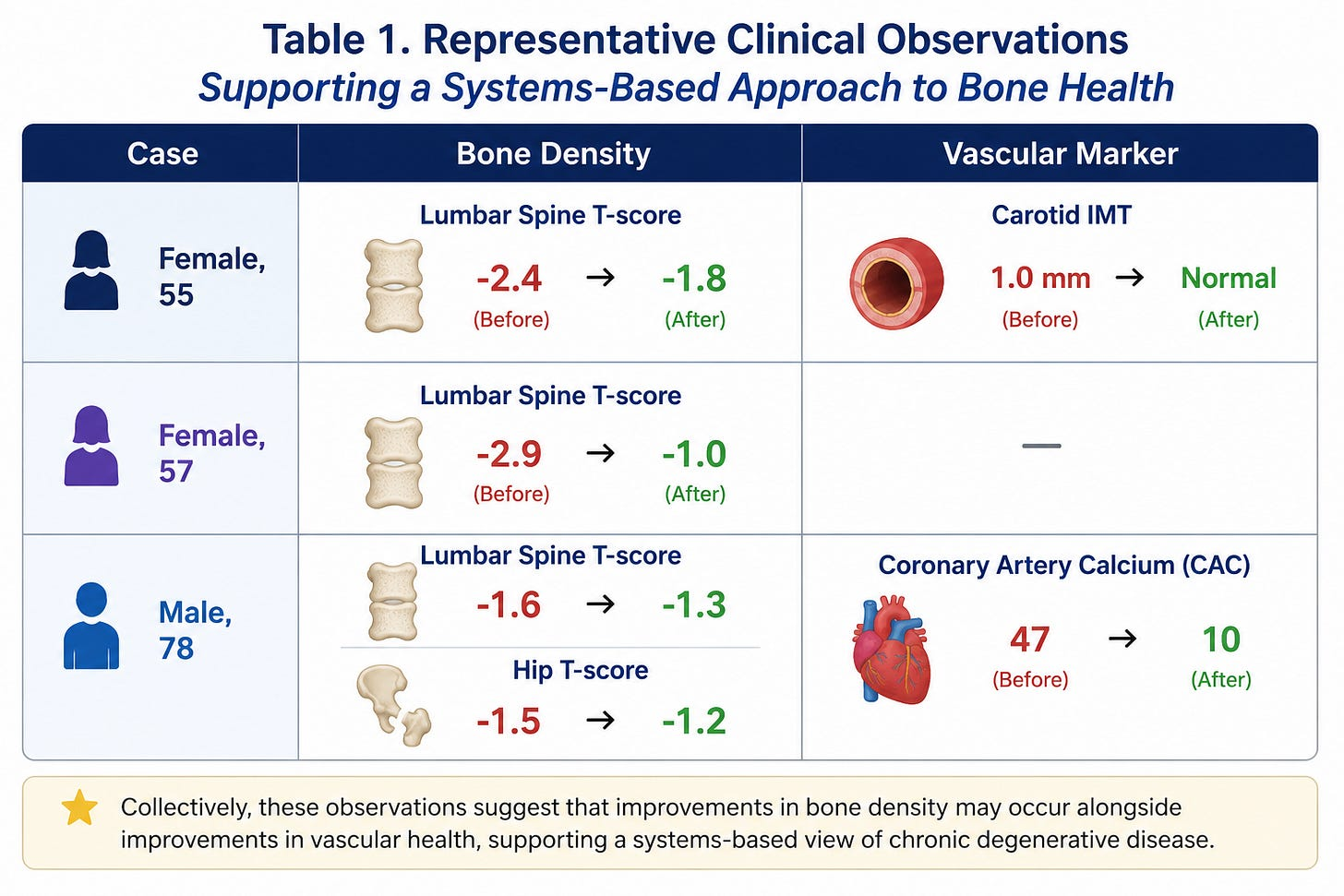
The table summarizes three representative clinical observations demonstrating improvement in bone density occurring concurrently with improvements in vascular health markers. Collectively, these observations suggest that improvements in bone density may occur alongside improvements in vascular health, supporting a systems-based view of chronic degenerative disease. Additional clinical observations, including long-term maintenance of excellent bone density and low coronary calcium burden in the author and several other patients, further support the hypothesis that bone health reflects broader metabolic, nutritional, hormonal, and vascular physiology rather than calcium metabolism alone. Representative clinical observations from our practice are summarized in Table 1. These cases demonstrate improvement in bone density occurring concurrently with improvement in vascular health markers, including carotid intima-media thickness (IMT) and coronary artery calcium (CAC) scores. Although such observations cannot establish causality, they are consistent with the hypothesis that osteoporosis may be better understood as a systems-level disorder involving multiple interacting biological processes rather than a simple deficiency of calcium alone. Notably, these observations suggest that improvements in bone density may occur concurrently with improvements in vascular health. This is consistent with the emerging concept that osteoporosis and vascular calcification may represent different manifestations of common underlying disturbances involving inflammation, oxidative stress, metabolic dysfunction, mitochondrial impairment, nutrient insufficiency, and biological aging. While such observations cannot establish causality and should not be generalized to all patients, they are consistent with the hypothesis that osteoporosis may be better understood as a systems-level disorder involving multiple interacting biological processes rather than a simple deficiency of calcium alone. Importantly, these findings do not invalidate the biological importance of vitamin D, calcium metabolism, vitamin C, or correction of true nutrient deficiencies. Rather, they may suggest that chronic degenerative disorders such as osteoporosis require broader systems-oriented interventions instead of isolated nutrient monotherapy alone. Rather than disproving the importance of nutrition, the BMJ findings may highlight the limitations of isolated nutrient interventions when applied to complex chronic diseases. From an IOM Systems Medicine perspective, osteoporosis is best understood not as a simple calcium deficiency disorder, but as a manifestation of broader disturbances involving connective tissue integrity, metabolic health, inflammation, hormonal balance, mitochondrial function, and biological resilience. Future advances in osteoporosis prevention and treatment may therefore depend on addressing the entire biological system rather than individual nutrients in isolation. ReferencesBMJ. Calcium and/or vitamin D supplementation for the prevention of fractures and falls. 2025.
Cheng RZ, Levy TE. Bone Health and Osteoporosis: An Orthomolecular Perspective. Orthomolecular Medicine News Service. 2022.
Reader Discussion and QuestionsOMNS welcomes comments, questions, ideas, experiences, and respectful dialogue from readers, patients, healthcare professionals, researchers, and students worldwide. We encourage participation on OMNS Interactive, where the exchange of knowledge and perspectives helps advance understanding and foster meaningful discussion. Join the conversation:
About OMNS InteractiveOMNS Interactive is the discussion and commentary platform of the Orthomolecular Medicine News Service (OMNS). The original OMNS website remains the official archive of OMNS publications. Subscribe to OMNS Interactive for future articles, commentary, and discussions:
Content is provided for educational purposes only and does not constitute medical advice. Follow OMNS Interactive
Orthomolecular MedicineOrthomolecular medicine uses safe, effective nutritional therapy to fight illness. For more information: http://www.orthomolecular.org Find a DoctorTo locate an orthomolecular physician near you: http://orthomolecular.org/resources/omns/v06n09.shtml The peer-reviewed Orthomolecular Medicine News Service is a non-profit and non-commercial informational resource. Editorial Review Board:
Jennifer L. Aliano, M.S., L.Ac., C.C.N. (USA)
Comments and media contact: editor@orthomolecular.org OMNS welcomes but is unable to respond to individual reader emails. Reader comments become the property of OMNS and may or may not be used for publication. To Subscribe at no charge: https://www.orthomolecular.org/subscribe.html To Unsubscribe from this list: https://www.orthomolecular.org/unsubscribe.html |

This website is managed by Riordan Clinic
A Non-profit 501(c)(3) Medical, Research and Educational Organization
3100 North Hillside Avenue, Wichita, KS 67219 USA
Phone: 316-682-3100; Fax: 316-682-5054
© (Riordan Clinic) 2004 - 2024c
Information on Orthomolecular.org is provided for educational purposes only. It is not intended as medical advice.
Consult your orthomolecular health care professional for individual guidance on specific health problems.
