 |
|
|
|
|
 Back to 2001 2nd Quarter Table of Contents
Introduction Cancer is the most feared of all diseases. People immediately associate cancer with dying. It affects two of every five Americans. The number of new cancer cases has been increasing over the past nine decades. According to the U.S Bureau of the Census, 47 people out of every 100,00 died of cancer in 1900, making it the sixth leading cause of death. Today, 170 people out of every 100,000 will die of cancer, ranking it second. In 1971, the United States declared war on cancer with the following statement from President Nixon “The time has come in America when the same kind of concentrated effort that split the atom and took man to the moon should be turned toward conquering this dread disease.” In that year, 337,000 people died of cancer and about $250 million were spent on cancer research. Since then, billions of dollars have been invested in cancer research. Approximately $120 billion are spent on cancer each year. Each month, it seems, new therapies are trumpeted some show promise, others fizzle quickly. Despite the enormous effort to combat cancer, the number of new cases of nearly every form of cancer has increased annually over the last century. Still worse, from 1930 to the present despite surgery, radiation therapy, chemotherapy, and all of our fancy medical technology life spans for almost every form of adult cancer (except lung and cervix) have remained the same which means there has been no significant progress in the treatment of adult cancers, including breast cancer. See Table 1, p.84.
The chilling prospect remains that two of every five Americans will develop cancer and the majority of them will die from it. Over 10 million people in the world developed cancer in 1996 and 6 million died of the disease. The number of deaths attributable to cancer around the world will be 6.7 million in the year 2015. And the majority of health budgets will be spent on treating cancer in most developing countries. Cancer is preventable by modifying lifestyle factors. Factors in Cancer After collating the existing cancer data, we found that 80-90% of all cancers are produced as a result of dietary and nutritional factors, lifestyle (smoking, alcohol consumption, lack of exercise), chemicals, and other environmental factors.1 This information has been corroborated by major agencies: the National Academy of Sciences,2 the U.S. Department of Health and Human Services,3 the National Cancer Institute,4 and the American Cancer Society. In addition to these lifestyle factors, estrogen has been recognized as a definite promoter of breast cancer. Individuals with high levels of estrogen, either endogenously produced or exogenously taken, have a high risk for developing breast cancer independently of all other risk factors.5,6,7 Nutritional factors account for 60% of women’s cancers, 40% of men’s cancers, and 65% of cardiovascular disease.2 Tobacco is related to about 30% of cancers and cardiovascular diseases. Like nutrition and tobacco, most other risk factors that cause disease are totally within our control alcohol, stress, sedentary lifestyle, substance abuse, etc. Strict genetics play a minor role in causing disease, including cancers and breast cancer, less than seven percent. Therefore, we can prevent many diseases when people learn about and implement a healthy lifestyle early in life as per our Simone Ten Point Plan. Table 1. United States Cancer Incidence.
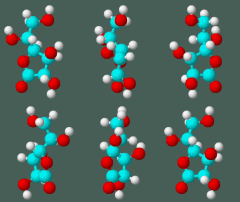
* The year Nixon declared War on Cancer N/A = not available Data from US Bureau of Vital Statistics and CA A Cancer Journal for Clinicians Point 1. Nutrition Maintain ideal weight. Eat a low-fat, high-fiber diet. Consume certain vitamins, minerals, and other important nutrients that help strengthen the immune system and detoxify the body. Take 325 mg aspirin every other day. Point 2. Tobacco: Don’t smoke, chew, snuff, or inhale other people s smoke. Point 3. Alcohol: Don’t consume more than two drinks a week Point 4. Sexual Social, Hormones, Drugs Avoid unnecessary hormones and drugs, and promiscuity. Point 5. Radiation Avoid unnecessary radiation and electromagnetic fields, wear sunglasses and use sunscreens. Point 6. Environmental exposure avoid pollutants. Point 7. Exercise Point 8. Stress Modification, Spirituality Point 9. Sexuality Point 10. Physical Examination Breast cancer is one of the major cancers in the world. The scope of this disease has been thoroughly reviewed.8 One woman in eight will develop breast cancer in her lifetime. In 2000, the number of breast cancer cases in the United States will be about 184,200: 182,800 women and 1400 men.9 Although African-American women are less likely to develop breast cancer than white women, they fair less well because they present to the physician later in the course of the disease with a more advanced stage. The number of new breast cancer cases increased from 82 per 100,000 women in 1973 to 132 per 100,000 in 1998. And the annual percentage increase is roughly two percent every year. When mortality figures are examined from 1930 onward, however, no change is seen in survival for women with breast cancer, which means there has been no change in the life span of women affected with breast cancer since 1930. At the request of the Congress in December 1991, the Government Accounting Office released its finding concerning breast cancer, Breast Cancer, 1971-1991: Prevention, Treatment, and Research. The report states that there has been no progress in the prevention of breast cancer or in the reduction of breast cancer mortality. The trend in mortality rates is upward. Treatment has improved survival only slightly. The five-year survival rate for breast cancer in 1976 was 75 percent; in 1983, 77 percent; in 1989, 78 percent; and, in 1995, 79 percent. Most scientists / physicians are convinced, however, that the slight increase in time of survival or life span is due largely to earlier detection of breast cancer by improved mammographic technology. But let us not forget what five-year survival means as defined by the oncologist. If a patient lives five years and one day, that woman is counted as a cure or survivor even though she has died. If, however, she lives one day less than five years, she is counted as a non-survivor. As countries around the world have become more westernized especially in their dietary habits, the number of deaths from diet-related tumors like breast cancer have increased. For example, Japanese women previously enjoyed a very low rate of breast cancer. It affected only 3.9 women per 100,000 between the years 1955 and 1959. It rose to 6.1 women per 100,000 during the years 1985 to 1989 and is still climbing. This trend is seen mainly in younger Japanese women who are more likely to have adopted Western ideas and habits, especially dietary habits.10 And Japanese women who immigrate to the United States have the same rate of colon cancer after only twenty years and the same rate of breast cancer after two generations. We are not winning the war on breast cancer with the current conventional approach; therefore, we must prevent it. The prevention of breast cancer, affecting one in eight women, and benign breast diseases, affecting 80 percent of women, should be of primary importance. The only way to prevent disease is through proper nutrition and other lifestyle modification. We now have the knowledge and tools to achieve substantial reductions in cancer rates and also significant gains in survival rates. What is needed is a coordinated program with a strong emphasis on prevention that specifically includes proper nutritional advice as well as advice on other lifestyle factors. Prevention of cancer, car-Cancer, Lifestyle Modification and Glucarate diovascular disease, and other chronic illnesses is feasible, economical, and makes a lot of sense. Glucarate or D-glucaric Acid Many nutrients can help strengthen the immune system and detoxify the body. Glucarate is one of a number of important nutrients that can help reduce risk. Multiple studies have demonstrated that D-glucaro-1,4-lactone and its precursor D-glucaric acid can: Turn on the process of glucuronidation that thereby detoxifies the body, control the progression of a cancer at particular stages, and have anti-proliferative effects. D-glucaric acid is a sugar acid derived from D-glucose in which both the aldehydic carbon atom and the carbon atom bearing the primary hydroxyl group are oxidized to carboxylic acid groups. D-Glucaric acid is found in abundance in cruciferous vegetables,11 sweet cherries,12 and citrus fruits.13 The scientific literature uses the following terms interchangeably with D-glucaric acid: calcium glucarate, glucosaccharic acid, L-gularic acid, levogularic acid, and tetrahydoxyadipic acid. Glucuronidation is the major detoxification system of the body. This process, using an enzyme called glucuronyl transferase, binds chemical carcinogens (like polycyclic aromatic hydrocarbons, nitrosamines, aromatic amines), toxins, and /or steroids with glucuronic acid (conjugation) and these bound carcinogens are detoxified and excreted out of the body.14-19 However, before they are excreted, these bound carcinogens can become free again (deconjugation) if and when beta-glucuronidase acts on them.20,21 The process of glucuronidation (detoxification) proceeds when the amount of glucuronyl transferase exceeds beta-glucuronidase. D-glucarolactone and its precursor, D-glucaric acid decrease the amount of available beta-glucuronidase. D-glucaric acid, Beta-glucuronidase Glucuronidation, Carcinogenesis Beta-glucuronidase is available in the body because it does provide for important functions. It releases active hormones and it also degrades oligosaccharides from hyaluronic acid and chondroitin.22 Glucuronidation is a major pathway to detoxify estrogens. Women at risk for breast cancer have low urinary estrogen glucuronides.22 Estrogens can initiate and/ or promote cancers, especially cancer of the breast.23 Estrogen can promote cancers especially when a person also consumes a diet that is high in fat and low in fiber; smokes; drinks alcohol; has a sedentary lifestyle; and other risk factors previously described.8 Detoxification Studies D-glucaric acid initiates and augments glucuronidation, the detoxification system of the body. D-glucaric acid is also a marker of glucuronidation. Several animal studies24-26 and multiple human studies demonstrate that D-glucaric acid can, in deed, turn on glucuronidation as well as be a good marker for detoxification.24, 27-39 Cancer Prevention and Anti-Cancer Studies Multiple in vitro and in vivo studies demonstrate that D-glucaric acid can prevent cancer, can decrease the proliferation of abnormal cells, and can be used effectively as an anti-cancer agent by itself or with other agents.40-86 Orally administered calcium glucarate is effectively utilized by the body because the acid environment of the stomach coverts it to D-glucaric acid. This immediately forms an equilibrium consisting of 40 percent D-glucaric acid, 30 percent D-glucaro-1,4-lactone, and 30 percent D-glucaro-6,3-lactone. Both the D-glucaric acid and the D-glucaro-1,4-lactone can turn on glucuronidation to detoxify the body and also have an anti-cancer effect.55 Both of these substances are found naturally in the body and in fruits and vegetables. Calcium glucarate has been used commercially for decades and has an advantage over D-glucaro-1,4-lactone. Calcium glucarate inhibits beta glucuronidase for over 5 hours when administered orally, whereas D-glucaro-1,4-lactone inhibits it for only 1 hour.51,80 D-glucarate alone or in combination with retinoids was effective in preventing carcinogenesis and also treating chemically induced cancers in animals. Anti-cancer effects were demonstrated even when retinoic acid was administered at suboptimal doses, but given with D-glucarate. D-glucarate is effective by itself and does not need to be converted to D- glucaro-1,4-lactone. The anti-cancer effects demonstrated by D-glucarate are via several mechanisms. First, D-glucarate effectively turns on the glucuronidation detoxification system. Second, it alters steroidogenesis production and also changes the hormonal environment. Together, this in turn affects the proliferative status of the target organ. In animals, D-glucarate can inhibit colon cancer, breast cancer, lung cancer, liver cancer, skin cancer, and urinary bladder cancer. D-glucarate inhibits or delays the promotion phase of breast carcinogenesis by lowering endogenous levels of estradiol and precursors of 17-ketosteroids as well as beta-glucruonidase. Patients who have fibrocystic breast disease have much higher levels of beta-glucuronidase than those patients who do not.62 Patients who were given D-glucarate after appropriate treatment for superficial or invasive urinary bladder cancer had much less recurrence rates at one and two years compared to those who were given D-glucarate. Common Sources of Glucaric Acid Common sources of glucaric acid include grapefruits, apples, oranges, grapes, peaches, plums, lemons, apricots, sweet cherries, spinach leaves, carrots, alfalfa sprouts, potatoes, Mung bean seeds, corn, cucumber, lettuce, cabbage, celery, green pepper, cauliflower, tomato, Brussel sprouts, Cancer, Lifestyle Modification and Glucarate Azuki bean sprouts, and broccoli. Glucaric acid is obtained from the diet in significant quantities ranging from approximately 0.1 g/kg in lettuce to 3.5 g/kg in apples and grapefruits. However, glucarate salts, including calcium glucarate, provide increased bioavailability and a longer timed release of glucaric acid found in foods. Calcium glucarate gets converted to glucaric acid in the acid environment of the stomac Risk/Benefit of the Impact of Lifestyle Changes Over 40 percent of Americans will develop cancer and the great majority of them will die from it. Amount of Glucarate Most studies express the amount of D-glucaric acid in terms of mmol/kg. However, the amount of D-glucaric acid in food and food supplements is expressed in grams, so we will go through the conversion of moles to grams. The chemical formula of glucarate is C6O8H8 and is therefore 208.112 grams per mole, or 208.112 mg/mmol.Studies that demonstrate benefit of glucarate use doses ranging from 4.5 mmol/kg40-45 to 128 mmol/kg.71-82 These doses convert to about 1 gram per kilogram of body weight to about 27 grams per kilogram of body weight. Safety of the Nutrient at Dose Levels and Consumption Levels Needed to Produce the Physiological Effect Glucarate is safe for prolonged periods of time at doses between 40-72 grams per kilogram of body weight. The data relating to glucarate are reliable, reproducible, and have a high level of credibility and competency. Conclusion Glucarate is safe. Glucarate can rid the body of pollutants, toxins, and carcinogens. Glucarate has anti-cancer properties. Glucarate is effective when administered orally. References
al: Harrison’s Principles of Internal Medicine. Twelfth Edition. 1991. New York. McGraw-Hill, Inc. 264-269.
24.Brunelle FM, Verbeeck RK: Conjugation-deconjugation cycling of diflunisal via beta-glucuronidase catalyzed hydrolysis of its acyl glucuronide in the rat. Life Sci, 1997; 60(22): 2013-2021.
1994. 46(7): 567-572.
40.AbouIssa H, Dwivedi C, Curley RW Jr, et al: Engineer FN, Humphries KA, el-Masry, Webb TE. Basis for the anti-tumor and chemopreventive activities of glucarate and the glucarate: retinoid combination. Anticancer Res, 1993; 13(2): 395-9 41. AbouIssa H, Koolemans-Beynen A, Minton JP, Webb TE. Synergistic interaction between 13-cis-retinoic acid and glucarate: activity against rat mammary tumor induction and MCF-7 cells. Biochem Biophys Res Comm, 1989, 29/ 163(3): 1364-9 42.AbouIssa H, Webb TE, Minton JP, Moesch Cancer, Lifestyle Modification and Glucarate berger M: Chemotherapeutic evaluation of glucarate and N-(4-hydroxyphenyl) retinamide alone and in combination in the rat mammary tumor model. J Natl Cancer Inst, 1989; 6/81(23): 1820-3.
47.Bhatnagar R, AbouIssa H, Curley RW Jr, Koolemans-Beynen A, Moeschberger ML, Webb TE: Growth suppression of human breast carcinoma cells in culture by n-(4-hydroxyphenyl)retinamide and its glucuronide and through synergism with glucarate. Biochem Pharmacol, 1991. 41(10): 1471-7.
of chemically initiated and promoted skin tumorigenesis in CD-1 mice by dietary glucarate. J Environ Pathol, Toxicol, Oncol, 1989; 9(3): 253-9.
TE, Rosol TJ, Au JL. Effects of 5-fluorouracil, leucovorin, and glucarate in rat colon-tumor explants. Cancer Chemother Pharmacol, 1992; 30(1): 25-30
80.Walaszek Z, Hanausek-Walaszek M, Webb TE: Repression of sustained-release glucuronidase inhibitors of chemical carcinogen-mediated induction of a marker oncofetal proteins in rodents. J Toxicol Environ Health, 1988. 23: 15-27. 81. Walaszek Z , Hanausek M , Adams AK, Sherman U: D-glucarate control of intestinal bacterial microflora and relationship to cancer prevention. Proc Annu Meet Am Assoc Cancer Res. 1992; 33:A982. 82. Walaszek Z , Szemraj J, Adams AK, Hanausek M: Reduced levels of D-glucaric acid in mammary tumor-bearing hosts and the effect of its supplementation during estrogen replacement and tamoxifen therapy. Proc Annu Meet Am Assoc Cancer Res, 1996. 37:A1254.
| |||||

This website is managed by Riordan Clinic
A Non-profit 501(c)(3) Medical, Research and Educational Organization
3100 North Hillside Avenue, Wichita, KS 67219 USA
Phone: 316-682-3100; Fax: 316-682-5054
© (Riordan Clinic) 2004 - 2024c
Information on Orthomolecular.org is provided for educational purposes only. It is not intended as medical advice.
Consult your orthomolecular health care professional for individual guidance on specific health problems.
 Download The Full Text Article in (PDF)